


Dynamic Customer Needs
Modern facilities - whether airports, hospitals, stadiums, or factories—demand more than basic communication. Today’s systems must be resilient, auditable and compliant, especially during emergencies.
National and regional fire and safety regulations are becoming more stringent, insurance demands more rigorous, and public authorities are requiring verifiable preparedness. Failures in communication during critical events have resulted in loss of life, legal issues and reputational damage—raising the bar for fully certified, standards-compliant systems.
In response, system owners and A&E consultants are prioritising solutions that:
- Comply with BS EN 50849 and BS 5839-8 standards
- Incorporate EN 54-certified equipment where required
- Reduce the risk of failure during emergencies
- Offer dual functionality for daily and emergency operations
Simultaneously, organisations are under pressure to reduce costs and deal with staff shortages. As a result, they are seeking multi-functional systems that not only support compliance but also automate routine tasks, improve responsiveness, and enhance overall safety and efficiency.
Emerging Trends in Critical Communication Systems
As the need for compliance-driven communication systems grows, emerging technology trends are offering solutions that not only reduce costs but also enhance operational efficiency, minimise response times and improve the overall safety and security of people and assets.
Harmonisation Between PA and VA Systems
With compliance becoming critical across public spaces, EN 54-16 has emerged as the globally recognised benchmark for the design and performance of Voice Alarm Systems. Adopting EN 54-16 is about meeting regulations and ensuring that systems can be trusted in critical moments.
Many countries outside the EU also reference or align with EN 54 standards in their building codes and fire safety regulations, especially in airports, metro systems, hospitals and high-occupancy buildings. We expect that this standard to be adopted across even a wider range of market verticals including corporate buildings, healthcare facilities and more.
Organisations often face the temptation to choose simple PA systems for cost savings. However, in environments governed by Martyn’s Law, a PA system alone is not compliant for emergency evacuation communication. Instead, investing in a hybrid PA/VA system that is EN 54-16 compliant allows allow venues to deliver both daily operational messaging and emergency evacuation commands from a single platform — lowering long-term maintenance costs and enhancing operational resilience.
Unification Beyond Harmonisation
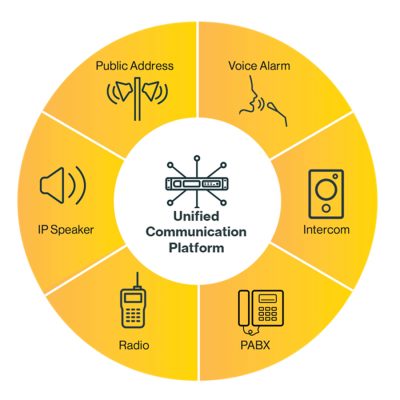
While harmonisation of PA and VA systems into a single hybrid solutions getting traction in the marketplace, there is another broader trend is emerging: the Unification of all communication technologies.
Communication needs are diverse, ranging from stationary to mobile, and from 2-way communication to broadcast. Today, we have multiple technologies such as intercom, telephony, radio, PA and VA systems, to address these diverse communication needs. However, these technologies were developed at different times and, more importantly, in isolation.
While they were designed to solve specific customer problems, they lacked a holistic approach from the outset. This has resulted in siloed communication systems that do not integrate with each other, creating several challenges for system owners.
However, not all hope is lost. With a unification approach, all critical communication technologies—such as intercoms, help points, radios, PA and VA systems—can be brought under a single unified platform. This allows security system owners to leverage a single platform while streamlining all types of communication more effectively.
This unification enhances situational awareness during emergencies for all stakeholders, providing them with the right tools to communicate seamlessly. Especially, merging security communication such as intercoms together with public address and voice alarm, allows security and safety teams to access and share information, such as an emergency incident reporting systems or a security violation.
As a result, decision-making becomes quicker, coordination smoother, and resource allocation more efficient in managing emergency situations. So, for example, security officers on patrol can now issue emergency messages using their radios. Or a surgeon in the operating theatre can issue a code-blue emergency announcement using the intercom.
Unifying communication systems streamlines both daily operations and emergency response. A central platform also makes it easier to monitor the entire system and keep it up to date, simplifying upgrades and maintenance.
The Future of Communication Technologies - Unified Communication Systems
As the demands on modern infrastructure continue to grow, the role of unified, compliant and intelligent communication systems becomes increasingly vital.
From daily coordination to life-saving emergency alerts, communication technologies such as PA, VA, intercom and radio systems form the lifeline of operations in critical environments.
However, today’s organisations must go beyond standalone systems and embrace unified solutions that deliver more than the sum of their parts. A unified platform that merges these technologies ensures better situational awareness, faster response times, reduced operational complexity and long-term cost efficiencies. More importantly, it ensures compliance with ever-tightening national and regional safety regulations, offering peace of mind during high-stakes moments.
By investing in systems that are not only built for performance but also designed for compliance and interoperability, facility owners can future-proof their infrastructure—ensuring safety, efficiency and resilience in the face of tomorrow’s challenges.
This article was written for iscve.org.uk

Sri Sutharsan is VP Marketing for Zenitel Safety & Security BU, a manufacturer of critical communication systems. With nearly 20 years of experience in R&D, Product Management, Sales, and Marketing, Sri has worked with global brands and businesses, assisting in setting vision and strategy for technology investments.